Kingdom: Animalia
Order: Hymenoptera
Family: Apidae
Genus: Xylocopa
Species: ~500 known
Size: 15–40mm (some tropical species)
Social structure: Mostly solitary; some primitively social
Nesting: Excavated galleries in dead wood, bamboo
Danger: Males cannot sting; females rarely sting
Range: Worldwide except polar regions
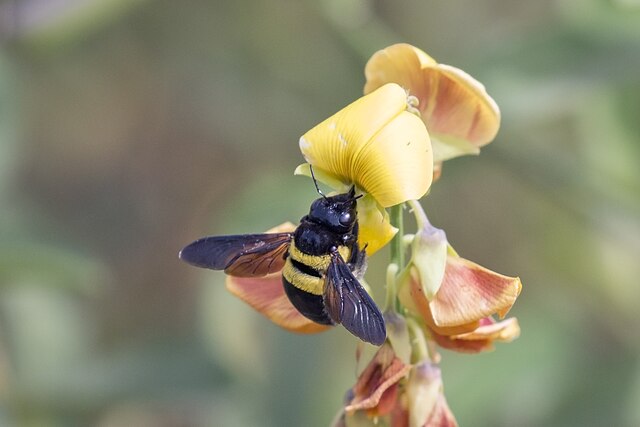
Eastern carpenter bee (Xylocopa virginica). Photo: Quartl, CC BY-SA 3.0.
Overview
Carpenter bees are among the most imposing insects in the gardens and woodlands of the Northern and Southern Hemispheres. Large, often glossy-black, and producing an audible buzz that commands attention, they are frequently mistaken for bumblebees or, more often, feared as aggressively stinging insects. Neither characterization is accurate. Carpenter bees are important pollinators of open-faced flowers and native wildflowers, architecturally impressive engineers of the insect world, and among the most docile of large bee species in the presence of humans.
The approximately 500 species of Xylocopa are found on every continent except Antarctica and are the dominant large solitary bees in most tropical and subtropical regions. They range in size from approximately 15mm in smaller temperate species to 40mm in some tropical species — making the largest carpenter bees among the largest bees of any genus in the world. Most North American species (notably Xylocopa virginica, the eastern carpenter bee, and Xylocopa tabaniformis, the valley carpenter bee of the western United States) are 20 to 25mm in length with a robust build and typically black and yellow coloration.
Nesting: Engineering in Wood
The defining characteristic of carpenter bees — and the source of both their name and their reputation as household pests — is their habit of excavating nesting galleries in dry, unfinished wood. A female carpenter bee selects a suitable piece of wood — typically dead wood, unpainted timber, fence posts, deck boards, or structural timbers — and begins excavating with her mandibles. She works against the grain for a short distance (typically 1 to 2 cm) to create an entrance tunnel, then turns and excavates with the grain for 10 to 30 cm or more, creating a smooth, perfectly circular gallery approximately the diameter of her own body.
The excavation of a gallery of this size — accomplished using only the bee's mandibles and legs — produces a quantity of sawdust that is clearly visible below the entrance hole and is often the first sign homeowners notice of carpenter bee activity. The gallery is then provisioned: the bee packs a ball of pollen and nectar at the back of the tunnel, lays a single egg on it, seals the cell with a plug of chewed wood pulp, and repeats the process, filling the gallery with sequential cells. A completed gallery may contain 6 to 10 cells.
Carpenter bees frequently reuse and extend galleries in subsequent seasons, and a gallery system used for multiple years may develop into an extensive network of tunnels running throughout a piece of timber. While rarely causing structural damage to sound wood, this activity can be cosmetically objectionable in finished woodwork and can accelerate decay in wood that is already weathered or damaged.
Are Carpenter Bees Dangerous?
This question is among the most frequently asked about carpenter bees, and the answer is straightforwardly reassuring. Male carpenter bees — which are conspicuous and often aggressive in their territorial behavior around nest sites, hovering in the faces of approaching humans and animals — physically cannot sting. Males of all bee species lack a stinger (the stinger is a modified ovipositor, present only in females). The "aggressive" hovering of male carpenter bees is entirely defensive display behavior with no capacity to cause harm.
Female carpenter bees possess a stinger and are capable of stinging, but they are extremely reluctant to do so. A female at her nest entrance will typically retreat into the gallery when approached. Females foraging on flowers almost never sting under any provocation short of being grabbed directly and handled roughly. In practice, carpenter bee stings are rare events that require deliberate and persistent interference with a female at close range.
The appropriate response to carpenter bees nesting in structural wood is tolerance where possible — they are beneficial pollinators — and physical exclusion or relocation where their nesting activity is genuinely problematic. Killing carpenter bees is rarely necessary and always ecologically costly.
Pollination Role
Carpenter bees are important pollinators of open-faced flowers — particularly those with a broad, accessible landing platform that accommodates their large body size. They are significant pollinators of passionflower (Passiflora), wisteria, various native wildflowers in the families Fabaceae and Solanaceae, and many tropical plants. In some plant communities, particularly in tropical South America and Asia, carpenter bees are the primary or exclusive pollinators of specific plant species.
Like bumblebees, some carpenter bee species are capable of buzz pollination — vibrating their flight muscles to release pollen from poricidal anthers. This capability makes them potentially important pollinators of crops requiring sonication, though they are less commonly managed for commercial pollination than bumblebees.
Carpenter bees are also notable nectar robbers. Their large body size prevents them from entering the narrow openings of tubular flowers to access nectar legitimately, so they sometimes bite a hole near the base of the flower tube to access nectar directly without contacting the anthers or stigma — collecting the reward without providing the pollination service. This behavior — well-documented in Xylocopa and other large bee genera — reduces the fitness of the robbed flowers and represents a breakdown of the normal mutualistic relationship between bee and flower.
Social Behavior
Most carpenter bee species are solitary — each female nests independently. However, some species show a primitive form of sociality: a mother and her adult daughters may share a nest, with the mother continuing to lay eggs while daughters assist with provisioning and defense. This simple form of cooperative nesting — below the complexity of bumblebee sociality but above the complete solitude of most bees — provides a potential evolutionary window into the origins of social behavior in bees.
A female carpenter bee can excavate approximately 2.5 cm of gallery per week — slow by human standards but remarkable given that the tool is her own mandibles working against hardwood. The gallery walls are smoothed to a near-perfect finish by the passage of the bee's body. Sawdust produced during excavation is pushed backward with the bee's legs and drops from the entrance hole — the characteristic yellow-brown pile below a carpenter bee's nest entrance.