| Quick Facts — Stingless Bees (Meliponini) | |
|---|---|
| Tribe | Meliponini (family Apidae, subfamily Apinae) |
| Known species | ~550 worldwide |
| Major genera | Melipona, Trigona, Tetragonula, Frieseomelitta |
| Distribution | Tropical and subtropical regions of every continent |
| Body length | 2–14mm depending on species |
| Colony size | 300–80,000 depending on species |
| Sting | Vestigial — cannot penetrate skin; defend by biting and resin |
| Honey production | Low volume; 1–3kg per colony per year (vs 30+ for honeybees) |
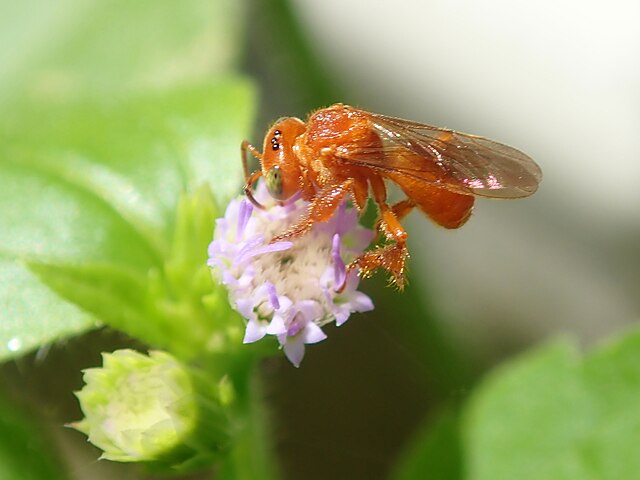
Stingless bees on flower. Photo: Wikimedia Commons, CC BY-SA 3.0.
Bees That Cannot Sting
Stingless bees are eusocial bees belonging to the tribe Meliponini whose ovipositor — the ancestral structure from which the bee sting evolved — has been reduced through millions of years of evolution to a vestigial organ incapable of penetrating mammalian skin. They are not defenseless: they defend their nests by biting, by entangling intruders in their legs, and by applying sticky plant resins — propolis — to anything that approaches too closely. Some tropical species produce caustic secretions or have powerful mandibles capable of drawing blood with their bite. But they cannot sting, and most species are entirely harmless to humans.
This property has made stingless bees uniquely suited to close partnership with human communities across the tropics. They can be kept in gardens, in homes, in small wooden boxes — without the defensive behavior concerns that accompany honeybee keeping. For indigenous communities across Mesoamerica, sub-Saharan Africa, Southeast Asia, and Australia, stingless bees have been kept as household animals for millennia.
Three Thousand Years of Meliponiculture
The keeping of stingless bees — meliponiculture — has been practiced continuously by the Maya people of Mesoamerica for over 3,000 years. The Maya kept Melipona beecheii — the royal stingless bee, known in Yucatec Maya as xunan kab ("royal lady") — in sacred log hives called jobones, associating them with the Bee God Ah Muzen Cab and incorporating their honey into religious ceremony, medicine, and fermented beverages.
Maya meliponiculture declined dramatically after the Spanish conquest disrupted indigenous agricultural and religious practices, but it has survived in rural communities of Mexico's Yucatán Peninsula as a living tradition. Contemporary efforts to revive meliponiculture as both a cultural heritage practice and a sustainable livelihood strategy have gained significant momentum, supported by indigenous organizations, academic researchers, and conservation NGOs.
Stingless Bee Honey
Stingless bees produce honey in quantities far smaller than honeybees — typically 1 to 3 kilograms per colony per year, compared to the 30 or more kilograms that a productive honeybee colony may yield. But what stingless bee honey lacks in volume it more than compensates for in complexity. The honey is stored in clustered wax pots rather than hexagonal comb cells, and its higher water content (20–35%) and distinctive suite of organic acids give it a flavor profile radically different from honeybee honey — more tart, more complex, sometimes almost wine-like.
In Brazil, Malaysia, Australia, and across the Mesoamerican tropics, stingless bee honey commands premium prices — sometimes exceeding $50 per 100ml — and is used in traditional medicine for eye infections, wound healing, and respiratory complaints. Scientific investigation of its antimicrobial and anti-inflammatory properties is ongoing and has found support for several traditional uses.
Ecological Role in Tropical Forests
In tropical rainforests — the most biodiverse ecosystems on Earth — stingless bees are among the most important pollinators. Their small size, diverse body forms, and willingness to visit a wide range of flower types make them effective pollinators for plant species that cannot be pollinated by larger bees. Some tropical plant genera are pollinated almost exclusively by stingless bees, making their conservation essential not just for the bees themselves but for the plants and all the animals that depend on those plants.