| Quick Facts — Sweat Bees (Halictidae) | |
|---|---|
| Family | Halictidae |
| Known species | ~4,400 worldwide |
| Distribution | Every continent except Antarctica |
| Body length | 4–18mm depending on species |
| Notable genera | Halictus, Lasioglossum, Agapostemon, Augochlora, Augochlorella |
| Social behavior | Ranges from fully solitary to primitively eusocial |
| Nesting | Primarily ground-nesting; some nest in rotting wood |
| Name origin | Attracted to human perspiration for salts and moisture |
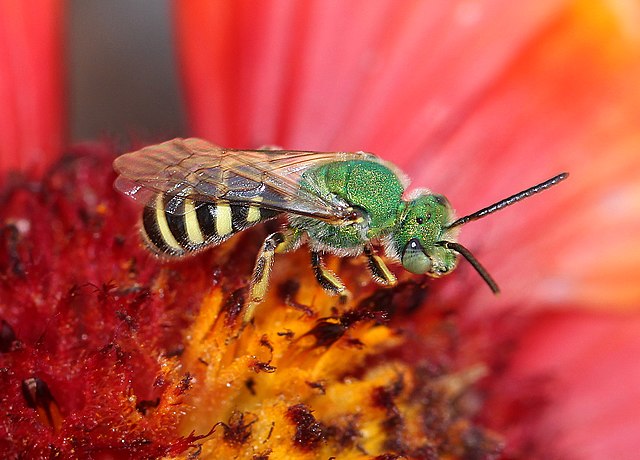
Metallic sweat bee (Agapostemon texanus). Photo: USGS Bee Inventory and Monitoring Lab, Public Domain.
The Most Visually Striking Bees in the World
Sweat bees are the bees most people have seen but never identified. That flash of metallic green on a flower petal, that iridescent copper-gold blur across a garden path — these are sweat bees, members of the family Halictidae, among the most species-rich and ecologically important bee groups on Earth.
Their extraordinary coloration — produced not by pigment but by the microscopic structure of their exoskeleton, which diffracts light like a prism — ranges from brilliant emerald green to blue-green, gold, copper, bronze, and purple. The structural color is so vivid that some species were historically mistaken for jewel beetles by early collectors. The North American genus Agapostemon — which combines a metallic green head and thorax with a striped amber abdomen — is particularly spectacular and commonly encountered in gardens across the continent.
A Family of Extraordinary Diversity
With over 4,400 known species organized into multiple subfamilies and dozens of genera, Halictidae is one of the largest bee families. Species range in body length from tiny 4mm Lasioglossum to robust 18mm Halictus. Their social behavior spans the full spectrum from completely solitary species, through communal nesting (where females share a nest entrance but each provisions her own cells), to primitively eusocial species with a reproductive queen and worker daughters — providing researchers with living models for the evolutionary origins of social behavior in insects.
The genus Lasioglossum alone contains over 1,700 species — more than any other bee genus — and includes both highly social and completely solitary species, sometimes within the same geographic region. Studying variation within Lasioglossum has been central to understanding how and why eusociality evolved in bees.
Why They Land on You
The common name "sweat bee" reflects a genuine behavior: many halictid species are attracted to perspiration on human skin, landing to lap up the salts, amino acids, and moisture it contains. This behavior is harmless — sweat bees are not aggressive and their sting, if it occurs at all, is among the least painful of any bee (Justin Schmidt's Insect Sting Pain Index rates most halictid stings at the lowest level). The attraction to sweat is particularly pronounced on hot summer days when natural salt sources in the environment are scarce.
Ecological Importance
Sweat bees are among the most important wild pollinators in temperate and tropical ecosystems. In North American meadows and agricultural landscapes, halictid bees are frequently the most abundant wild bee group, visiting a vast range of flowering plants. Several species are significant crop pollinators — particularly for sunflowers, alfalfa, stone fruits, and various vegetable crops. Their small size allows them to access flowers that larger bees cannot enter efficiently, and their abundance ensures high pollination visitation rates even in landscapes where larger bee species have declined.
In tropical regions, halictid diversity is particularly high and the ecological roles of individual species are less well characterized — a reflection of the general under-study of tropical bee communities relative to their temperate counterparts.
Nesting and Life Cycle
Most sweat bees nest in the ground, excavating tunnels in bare or sparsely vegetated soil. Social species construct communal nests with a main tunnel from which individual brood cells branch off. The queen lays eggs in each cell and workers provision them with pollen and nectar. Solitary species build and provision their own nests independently, with no assistance from offspring or nestmates.
In temperate regions, most halictid species are annual — mated queens overwinter in the soil and found new nests in spring. Social colonies grow through summer, producing reproductive females and males in late summer for mating. Only mated queens survive winter. Some species produce two broods per year in warmer climates.