| Quick Facts — Cuckoo Bees | |
|---|---|
| Classification | Polyphyletic group — cuckoo behavior evolved independently across multiple bee families |
| Proportion of bee species | ~15% of all known bee species are cleptoparasites |
| Major genera | Nomada, Sphecodes, Coelioxys, Stelis, Holcopasites, Epeolus, Triepeolus |
| Families represented | Apidae, Halictidae, Megachilidae, Colletidae |
| Pollen-collecting structures | Absent — no scopa or corbicula; they do not provision their own nests |
| Behavior type | Cleptoparasitism (stealing provisions) rather than true parasitism |
| Host specificity | Usually highly specific — most species parasitize one or a few host genera |
| Sting | Present in females; often used to kill host eggs and larvae |
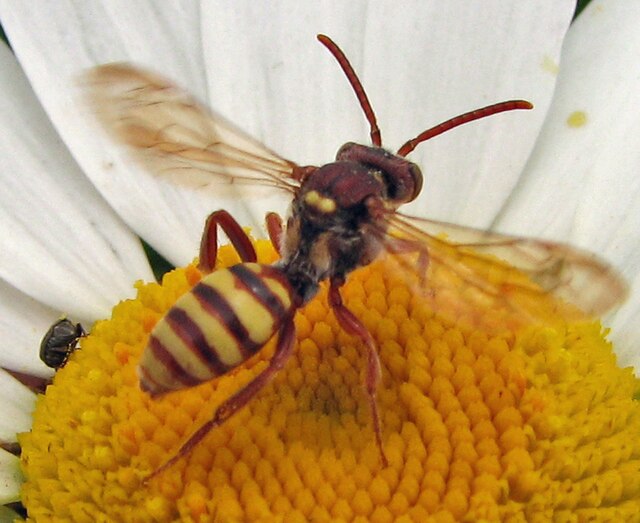
Cuckoo bee (Nomada flava). Photo: Gail Hampshire / Flickr, CC BY 2.0.
Nature's Nest Thieves
The cuckoo bird is famous for laying its eggs in other birds' nests, leaving the host parents to raise its chick — often at the expense of their own offspring. The same strategy, refined over millions of years of parallel evolution, has produced the cuckoo bee: a bee that has dispensed entirely with the exhausting work of nest construction and pollen foraging, instead investing its energy in locating host nests and inserting its own eggs into them.
The term for this behavior is cleptoparasitism — theft of provisions — as distinct from parasitism in the strict sense. The cuckoo bee does not directly harm the host adult bee (usually). It steals the food she has laboriously collected for her own offspring. The host's larva, finding its cell already occupied by a cuckoo bee larva, is killed or starved; the cuckoo larva consumes the pollen provisions meant for the host and emerges as an adult bee that will itself seek out host nests to parasitize.
That approximately 15% of all bee species have independently evolved this strategy — across multiple bee families, on every inhabited continent — is a testament to its evolutionary success. Where there are provisioning bees, there are almost always cuckoo bees evolved to exploit them.
Anatomy of a Parasite
Cuckoo bees are immediately recognizable to the trained eye by what they lack. A foraging bee — whether honeybee, bumblebee, mason bee, or mining bee — carries the unmistakable equipment of pollen collection: the dense, branched body hair that traps pollen grains, the corbicula (pollen basket) or scopa (pollen-carrying abdominal hairs) that holds the collected load. Cuckoo bees have none of this. Their bodies are comparatively smooth and wasp-like, their legs slender and unburdened. They have no need for pollen-collecting structures because they never collect pollen.
In their place, cuckoo bee females have evolved adaptations for infiltrating and surviving in host nests. Many species have thickened, heavily armored exoskeletons that protect them from host stings during nest entry. Some have chemical mimicry — producing or acquiring chemical signals that match the cuticular hydrocarbons of their host species, allowing them to enter nests without triggering defensive responses. Female cuckoo bees typically have a sharp, robust ovipositor used both for stinging host eggs and larvae and for inserting their own eggs into host cells.
Major Cuckoo Bee Groups
Nomada — The Wasp-Mimics
Nomada is one of the largest and most widespread cuckoo bee genera, with over 800 described species found across the Northern Hemisphere. They are slender, yellow-and-black or red-and-black bees that superficially resemble small wasps — a resemblance that may itself be protective, deterring predators that have learned to avoid stinging wasps. Most Nomada species parasitize mining bees of the genus Andrena, and the two genera often co-occur in the same habitat — the cuckoo dependent on the abundance of its host. Nomada females are frequently seen flying low over the ground in spring, patrolling for host nest entrances.
Sphecodes — The Blood Bees
Sphecodes, commonly called blood bees for the deep red coloration of their abdomen, are cleptoparasites of sweat bees in the family Halictidae. Their vivid red abdomen against a black thorax makes them among the most visually distinctive of all cuckoo bees. Like Nomada, they are frequently found patrolling the same habitats as their hosts. The female enters a host nest, kills or eats the host egg, lays her own egg, and departs — leaving the host's provisioned cell to raise her larva.
Coelioxys — The Leafcutter Parasites
Coelioxys, with over 500 species worldwide, primarily parasitize leafcutter bees (Megachile) and digger bees (Anthophora). They are recognizable by their sharply pointed abdomens — an adaptation for piercing the sealed leaf-pulp caps of leafcutter bee cells to insert eggs. The pointed abdomen is one of the more elegant morphological adaptations in the bee world: a tool precisely shaped by evolution for a single purpose.
Epeolus and Triepeolus — The Polyester Bee Parasites
Epeolus and Triepeolus are cuckoo bees that primarily parasitize plasterer bees (family Colletidae). They are often boldly patterned in black and white or black and yellow, with a dense, felt-like pubescence that gives them a distinctive textured appearance. Many are specialists on particular Colletidae genera, and their distribution closely tracks that of their hosts.
The Evolutionary Arms Race
The relationship between cuckoo bees and their hosts is a classic evolutionary arms race. As hosts evolve better detection of parasites — improved chemical recognition, more vigilant guarding behavior, faster cell sealing — cuckoo bees evolve better counter-measures: more sophisticated chemical mimicry, faster egg deposition, more effectively armored bodies. The result is a co-evolutionary dynamic that has been running for millions of years without resolution, maintaining both host and parasite populations in dynamic equilibrium.
Host bee populations that are reduced by any external cause — habitat loss, pesticide exposure, disease — typically show corresponding reductions in their associated cuckoo bee populations, since the parasite is entirely dependent on the host's continued abundance. This tight dependency makes cuckoo bees among the most sensitive indicators of host bee population health, and their disappearance from a habitat often signals problems in host populations before those problems become directly measurable.
Cuckoo Bees as Pollinators
Cuckoo bees do visit flowers — they need nectar for their own nutrition, and in doing so they incidentally transfer pollen. But because they lack pollen-collecting structures and are not making repeated, efficient visits to provision nests, they are considerably less effective as pollinators than their hosts. They are opportunistic flower visitors rather than dedicated pollinators. Their ecological value as pollinators is secondary to their role as consumers of host bee provisions — and their conservation value lies primarily in what their presence or absence reveals about the health of the host bee communities they depend on.
Cleptoparasitism has evolved independently at least 31 separate times within bees — making it one of the most striking examples of convergent evolution in the insect world. Every major bee family contains cleptoparasitic lineages that evolved from provisioning ancestors. The consistency with which bees "discover" this strategy across completely unrelated lineages speaks to its fundamental evolutionary logic: where there is a reliable food cache, there is evolutionary pressure to exploit it.